The Enterprise Foundation: Angular & TypeScript
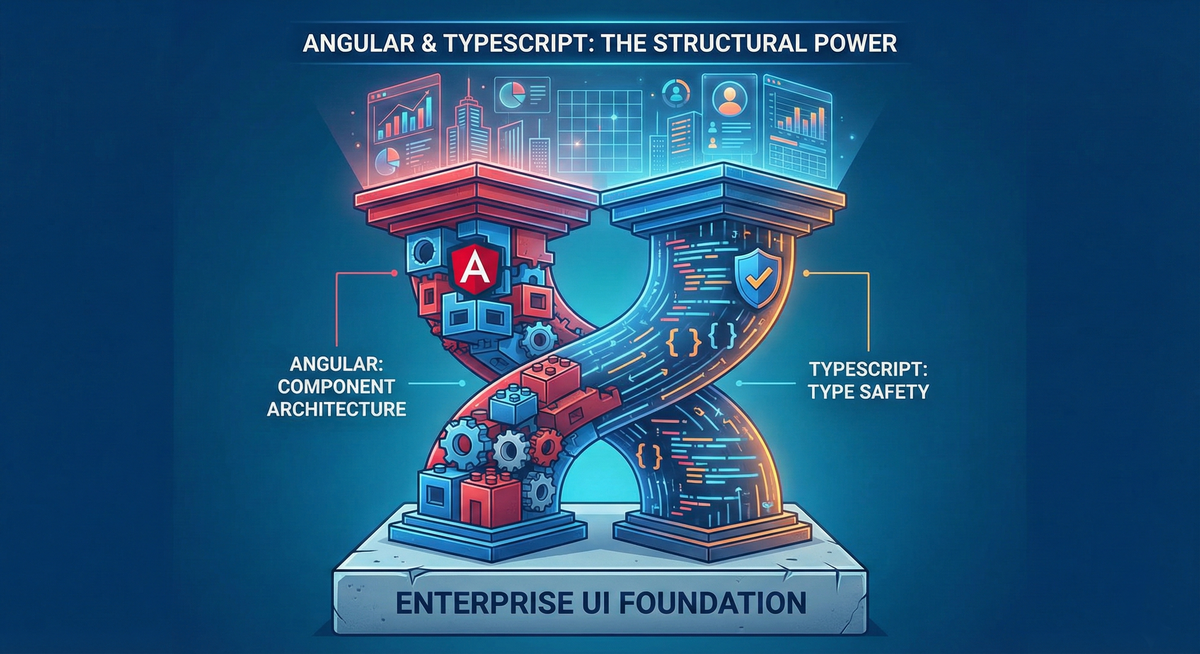
In the world of complex, large-scale web applications, structure and safety are not optional—they are essential. Built specifically for this environment, Angular commands a powerful architecture, flawlessly complemented by TypeScript's rigorous type system. Together, they provide a bedrock for engineering teams to build scalable, maintainable, and high-quality software.
This guide explores the two pillars of this foundation: component architecture and type safety.
Pillar 1: The Structural Power of Component Architecture
Angular's primary source of structural power lies in its component-based architecture. Instead of a monolithic block of code, an application is defined as a tree of loosely coupled, highly cohesive components. This approach is critical for enterprise development for several reasons:
Modular & Reusable: Every piece of the UI—from a simple button to a complex data grid—is a self-contained component with its logic (TypeScript class), template (HTML), and styles (CSS/SCSS). This modularity allows teams to build a library of reusable building blocks, ensuring consistency across the application and drastically reducing development time.
Separation of Concerns: A component's responsibility is strictly defined; it manages a specific patch of screen real estate. Business logic, data fetching, and state management are delegated to services, which are injected into components via dependency injection (DI). This clean separation makes components lighter, easier to test, and simpler to understand.
Scalability via Modules (and Standalone Components): Angular organizes components into logical functional units called Modules (NgModules). Modules such as UserManagementModule and ProductCatalogModule, which encapsulate related capabilities, enable different teams to independently work on separate parts of the system without interfering with each other. Modern Angular also supports standalone components, which simplify the procedure further by removing the need for module files in many cases, making the architecture even more flexible.
Maintainability: When a bug occurs or a feature needs updating, developers know exactly where to look. The directory structure mirrors the application's visual structure, making navigation intuitive even in massive codebases.
In Practice: Imagine an enterprise ERP system. You wouldn't build it as one giant page. You'd break it down:
A generic <app-data-grid> component to display tabular data.
An <app-employee-card> component used within an employee directory feature.
The UserProfileModule combines all components and services necessary for managing user settings.
Pillar 2: The Safety Net of TypeScript
If component architecture provides the structure, TypeScript provides the safety net. As a typed superset of JavaScript, TypeScript introduces static analysis to your workflow, catching errors during development that would otherwise crash your application in production. For enterprise teams, its benefits are transformative:
Early Error Detection: This is the single biggest advantage. TypeScript acts as a vigilant pair of eyes, flagging type-related mistakes as you type. Are you attempting to pass a string to a function that requires a number? Are you attempting to access a property that doesn't exist on an object? TypeScript will stop you immediately with a clear error message in your IDE, long before the code runs in a browser.
Self-Documenting Code: Types serve as living, enforced documentation. When you see a function signature like getUser(id: number): Observable<User>, you instantly know what input it requires and what output it promises. This is invaluable for onboarding new team members and understanding complex APIs without having to dig through implementation details.
Supercharged Refactoring: In a large enterprise codebase, refactoring is a constant reality. In plain JavaScript, renaming a property or altering a method's signature can be a challenging process of searching and replacing. With TypeScript, you can rename a symbol across thousands of files with a single click, confident that the compiler will catch any broken references.
Enhanced Developer Productivity: Modern IDEs like VS Code leverage TypeScript to provide intelligent code completion (IntelliSense), quick navigation ("Go to Definition"), and inline documentation. This speeds up coding and reduces the cognitive load on developers.
In Practice: Without TypeScript, a developer might write code that accidentally sends an incomplete user object to a backend API, causing a silent failure.
JavaScript
// Plain JavaScript - Potential for runtime error
function updateUser(user) {
  // What properties does 'user' have? We don't know for sure.
  api.post('/user/update', { id: user.usrId, name: user.name }); // Typo: usrId instead of userId
}
With TypeScript, the compiler prevents this mistake:
TypeScript
// TypeScript - Enforced safety
interface User {
  userId: number;
  firstName: string;
  lastName: string;
}
function updateUser(user: User) {
  // Compiler error: Property 'usrId' does not exist on type 'User'. Did you mean 'userId'?
  api.post('/user/update', { id: user.usrId, name: user.firstName });
}
Conclusion
Angular and TypeScript are not just a popular combination; they are a strategic choice for enterprise engineering. Angular's component architecture provides the blueprint for building scalable and maintainable systems, while TypeScript's type safety ensures those systems are robust and error-resistant. Together, they form the bedrock upon which confident, high-velocity engineering teams build mission-critical web applications.